You Can't Save The Planet: Own Your Share Instead

There's an elephant in the room when it comes to sustainable living that we all feel but rarely say out loud: shame.
Not just guilt about flying, or recycling wrong, or buying something you didn't need. Deeper than that. The quiet, nagging feeling that it doesn't even matter to try. That you're doing damage just by being here, and that whatever you're doing to offset it isn't ever enough.
I was listening to a podcast recently where someone expressed genuine despair about the state of the planet. Not frustration — despair. The feeling that we've gone too far, done too much damage, and that no amount of individual effort moves the needle on any of it. I heard that and it resonated a lot with a part of me. I've been in that place. People who pay attention to the damage we do might also be familiar with that feeling.
That feeling does one of two things to people. It either loads you with personal guilt — the recycling anxiety, the flight shame, that feeling that your existence is net-negative, and drives you to want to do more...
Or it does the opposite: it makes you check out entirely, because if the problem is that large and your contribution that small, why exhaust yourself over it?
Both responses make sense. Depending on the day, I may feel one or both.
This post is for the second group especially — the people who have quietly given up. Who looked at the scale of climate change, or ocean plastic, or factory farming, or any of it, and decided their piece of it was too small to bother with. I want to offer one thought that sometimes helps me when I'm in that place.
Before I do — a disclaimer: this is not an argument for doing less. It's not pushing individual action to mask the need for systemic action. It's not permission to pollute and feel fine about it. It's permission to forgive yourself enough to keep going — because guilt that paralyzes you helps nobody. Not you, not the planet, not the people you'll never meet who bear the cost of collective harm.
The Math
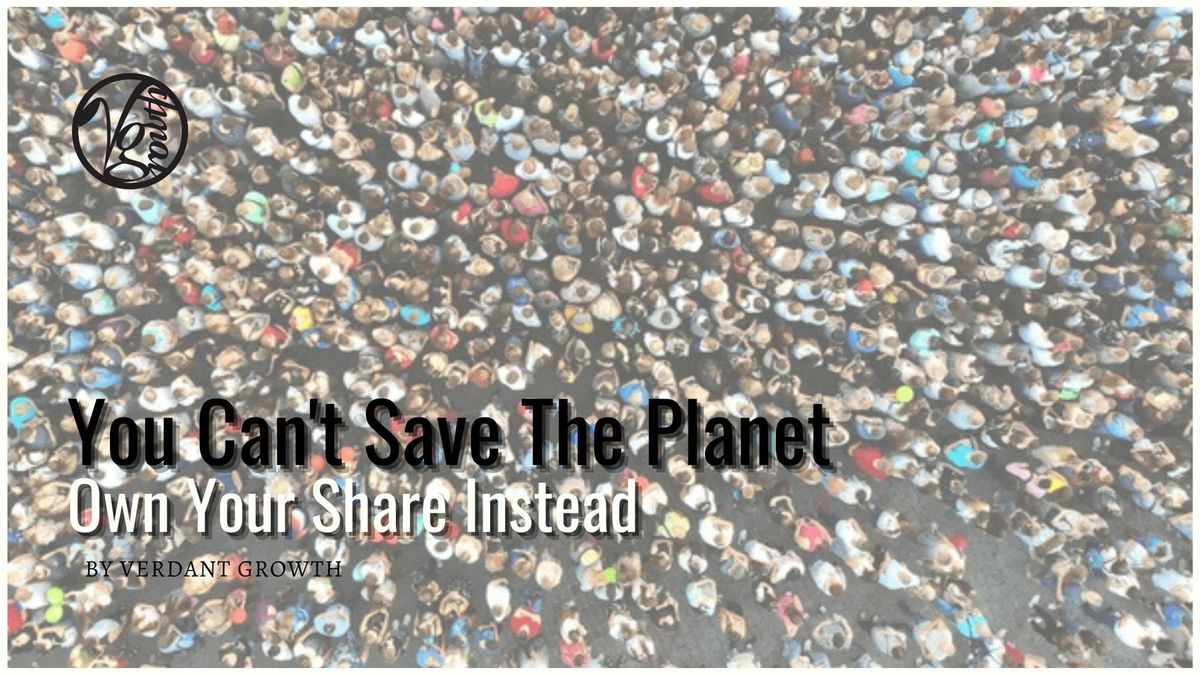
You are one of approximately 8 billion people on this planet.
As a fraction: 1/8,000,000,000.
As a decimal: 0.000000000125.
That number is your share of the problem. Or, with a reframe — your share of the solution. Assuming you're an ordinary person without extraordinary wealth or institutional power, that is the precise size of your jurisdiction over harm done to this planet and the people on it.
Worth clarifying what "harm" actually means here, because it's bigger than carbon. Your negative effects on the world aren't only CO2. They're the packaging you throw away, the noise you make, the way you drive, what you buy and who made it under what conditions, and — less obviously — how you treat people in passing. Climate change is the environmental monster that dominates the headlines, but your pollution is broader than that.
Back to the fraction. Knowing you're one of eight billion can pull you in two directions simultaneously, and I'll be honest that I live somewhere between them depending on the day. On the low end: my share is so vanishingly small it barely registers, so why exhaust myself over it? On the high end: my share is entirely mine, which means I'm in complete control of it and should treat it accordingly. Where I land on any given week has less to do with my values than with the news cycle, my stress level, and whether my three-year-old is cooperating.
But here's what the math is actually saying, underneath both of those reactions: your job is exactly 1/8,000,000,000th of the problem. No bigger. No smaller. Most of the guilt you're carrying belongs to the other 7,999,999,999 people. Accepting that isn't an excuse to do nothing. It's a job description — finally the right size to actually work with.
And here's what I want you to notice about that: it doesn't make you powerless. It makes you precise. When you stop looking at the entire problem — all the things you can't control, all the systems too large to move, all the other eight billion people not doing their part — and you focus on your one fraction instead, something shifts. That's where the control actually lives. That's where you can act.
A Note on Influence
This math assumes you're a reasonably ordinary person. If you run a company, hold political office, or have a platform that shapes how large numbers of people think and buy, your fraction has a multiplier. That's a different conversation and a genuinely different responsibility. The acceptance I'm describing here is not a pass for people with outsized power to tend only their own garden. It's directed at the rest of us — the ones who've been made to feel personally culpable for a systemic problem while the people with actual leverage look the other way.
What Acceptance Actually Unlocks
When you stop trying to fix everyone else's share — or measuring your behavior against what other people are or aren't doing — you can finally look at your own clearly.
For me, that's where the framing shifts entirely. I'm not trying to "save the planet." I'm trying not to harm people I'll never meet. Those sound similar but they feel completely different. One is an impossible project. The other is just a question: does this choice cause harm I don't need to cause? That's a question I can actually answer, most of the time.
Most of the time.
A month ago, I was trying to figure out what to do with a broken microwave. I was burned out at work. My toddler was deep in an aggressive "No!" phase. The microwave had stopped working and I needed it gone, and the simple question of what to do with it felt genuinely insurmountable. Buy a new one and absorb the guilt? Find someone to repair it, at a cost higher than just buying a new one? Track down an electronics recycling center? Just throw it in the trash and feel bad about it later?
I ended up scheduling a special waste pickup for electronics. And I still feel like I took an easy out — that a better version of me, in a better week, would've found a more dignified solution for the thing.
That's the honest reality of trying to live by your values. You don't always succeed. Sometimes the most sustainable choice loses to exhaustion, or a toddler, or the fact that it's Tuesday and you're just trying to get through it.
Handling the Feeling of Failure
In the moments when I feel like I got it wrong, I try to hold two things at once: be kind to myself, without completely letting myself off the hook.
I was born into this system. I was raised inside it. The infrastructure of modern convenience was built before I arrived and I navigate it imperfectly, like everyone else. That's real context. It's not an excuse.
The guilt that paralyzes you isn't useful. It doesn't produce better choices — it produces avoidance. What actually produces better choices is coming back to the fraction. My jurisdiction is small. It's specific. It's entirely mine.
And once you've made peace with that — once your fraction feels like yours rather than like a consolation prize — something else becomes possible. You start to influence the people around you. A conversation, a choice someone notices, a small thing that makes someone else think. If you can bring one other person along, you've doubled your impact. That's when the fraction starts to grow.
The Close
The guilt that brought you to this post — the despair, the paralysis, the feeling that nothing you do matters — I understand it. But it's the wrong size. It's everyone's problem loaded onto your shoulders, and that's not a weight anyone can actually move under.
Your share is smaller than that. It's specific. It's entirely yours. And the only question worth asking is: what do you want to do with it?
That's a small enough question to answer. Maybe that's the good news.