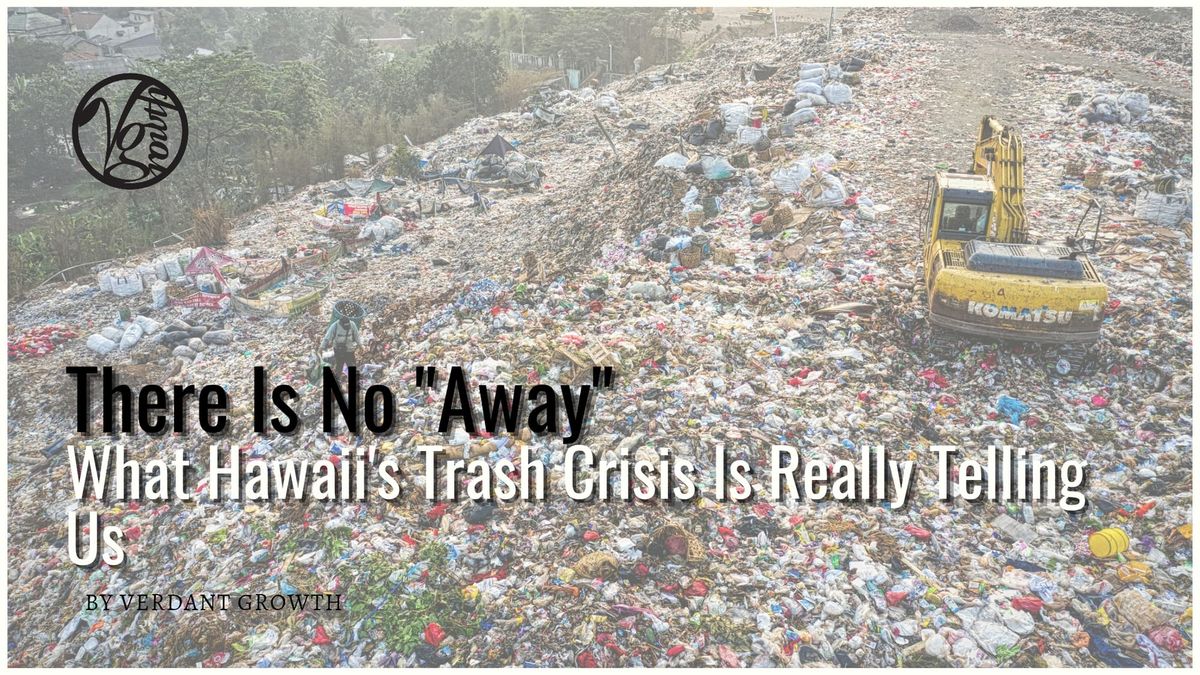
There Is No "Away": What Hawaii's Trash Crisis Is Really Telling Us

I was waiting for an elevator in the lobby of a building I was catsitting at. I pushed the elevator call button and stared blankly at the wall. There were various notices to the residents, but one was printed on bright yellow paper, like a warning notice. My eyes caught a few words on the page and I realized what I was staring at: a notice to the residents that “Large item garbage collection is temporarily suspended as the City & County of Honolulu’s current landfills have reached maximum capacity.”
My mind immediately jumped to an idea I had a few years back but hadn't thought of in a while: Hawaii is a small-scale version of the whole planet. What is happening here right now is an example of what we will see everywhere in the coming decades - resources stretched thin, skyrocketing costs for essentials, insufficient land for waste dumping, and no end in sight to all of the problems that have gotten us here.
I searched on my phone and saw that indeed, our current primary landfill on the island is expected to reach maximum capacity within the next 2 years, and our governor was promising the people of the West side of the island (guess who predominantly lives there? I'll give you a hint, it's not the upper class residents) that no new landfills would be placed anywhere near their land.
Leaving precisely…zero possible locations for a new landfill.
It was something I was vaguely aware of as being inevitable, but this was bringing the sharp slap in the face of reality to my life.
Hawaii as Microcosm
We’re in trouble, to be sure. But this isn't just a “trash crisis in paradise”. It's showing us, in miniature, what happens when a finite place runs out of room to hide the downstream effects of a culture obsessed with unlimited growth and unrestrained capitalism and materialism.
Sure, we can ship our garbage somewhere else. But why? It's just kicking the can down the road. The math eventually means that, with a waste that doesn't disappear for 10,000 years (Looking at you, plastics) being produced by the millions of tons per day, we're going to fill up every landfill and eventually every bit of land with waste until we decide to just turn off the tap. Until we stop using plastics.
This is when the reality starts to set in: when you “throw away” something, you're literally doing just that: throwing it “away” from you, but somewhere not too far away…in nature. In my case, it's just to the other side of the island a short 45 minute drive away. There is no such thing as “away.” And guess what? The world itself is an island.
There Is No "Away."
The problem isn't just that we're running out of landfill space. It's that we ever believed "throwing something away" was a real thing in the first place.
Every piece of plastic packaging you've ever touched still exists somewhere. It didn't disappear when you dropped it in the bin. It made a short trip — in my case, a 45-minute drive to the west side of the island — and sat down in a hole in the ground. And now that hole is full, and we're arguing about whose backyard gets the next one.
This is what "away" actually means. It means someone else's neighborhood. It means out of sight. It means “not my problem anymore.”
Except it is. It always was.
The Food Connection
Here's something that really surprised me when I looked into it: Hawaii imports roughly 85–90% of its food. Almost everything on your plate — the lettuce, the eggs, the yogurt, the snacks — arrived on a container ship, probably wrapped in plastic, from 2,500 miles away. And that packaging doesn't evaporate at the curbside. It becomes exactly the problem we just described.
For how much food waste goes to the garbage here in Hawaii, estimates sit at nearly $700 of food per person per year — about a third more than the national average — and most of it ends up in a landfill (that now only has two years left).
The part that really gets me: this island can grow things. It has rich volcanic soil and a year-round growing season. Hawaiian people lived here sustainably for the better part of a millennium without depleting the resources. Granted, we have a lot more people now, but researchers at UH have found that Hawaii has the agricultural capacity to feed the vast majority of its own population, even with how overpopulated it is.
And yet we're shipping lettuce in from California in plastic clamshells and then throwing half of it away.
We built this dependency. That means we can — slowly, imperfectly — start to dismantle it, if we choose to.
What We Can Actually Do
So here's where I want to resist the urge to tell you what to do, because I don't think that's the point. But I do think it's worth naming the levers that actually exist, because this isn't a problem where individuals are powerless. We actually have a lot of power here.
We can reduce how much we consume in the first place. We can refuse to buy things packaged in plastic — especially things that were shipped here from somewhere else when a local alternative exists. We can buy from farmers markets and local producers. We can grow something, even if it's herbs on a windowsill. We can compost our food scraps instead of landfilling them.
None of this is radical. None of it requires suffering or sacrifice. It just requires paying attention to where things come from and where they go.
And until we've done all of those things, we haven't earned the right to complain.
The Island (And Nature) Doesn't Lie
What I keep coming back to is this: islands (and all of nature, really) are honest. Nature doesn’t care what your reasons or excuses are. It will show you the consequences of your actions whether you like them or not. But on an island, because of how small it is, it’s much easier to see.
On the mainland, you can always export the consequences. Ship the waste to a rural county (or small, poor country like Indonesia, India, or the Phillipines). Build the landfill somewhere people won't notice. The distance between cause and effect gets stretched until it's invisible.
Here, the farthest distance is 45 minutes. You can drive past the landfill on the way to the beach (if you know where it is, they do a pretty good job of hiding it). You can watch the city run out of options in real time, site by site, vote by vote, until there's nothing left.
That's uncomfortable. But it's also clarifying.
The world is doing what Oahu is doing. Just more slowly, and with more room to pretend otherwise. The trash doesn't disappear. The math doesn't change. And the longer we wait to turn off the tap, the fewer options we'll have left when the moment of reckoning finally arrives — not as a headline in someone else's city, but in ours.
The island already knows this. The question is whether we're ready to listen.
We Can Choose
Most of us didn't choose this system. We were born into it, handed a bin, and told where to put things. But we've been making choices inside it every day — what to buy, what to refuse, what to grow, what to compost. The question isn't whether the system needs to change. It does. The question is whether the life you're living right now is one you actually chose, or just one you never got around to examining.