THE PATCH: How GLP-1s Are Selling Us a Fix for a Problem We Refuse to Name
Food companies spent decades engineering the perfect craving. Now another industry is making billions helping us silence it. GLP-1s may be changing how we eat—but are we treating the symptom while leaving the system untouched?

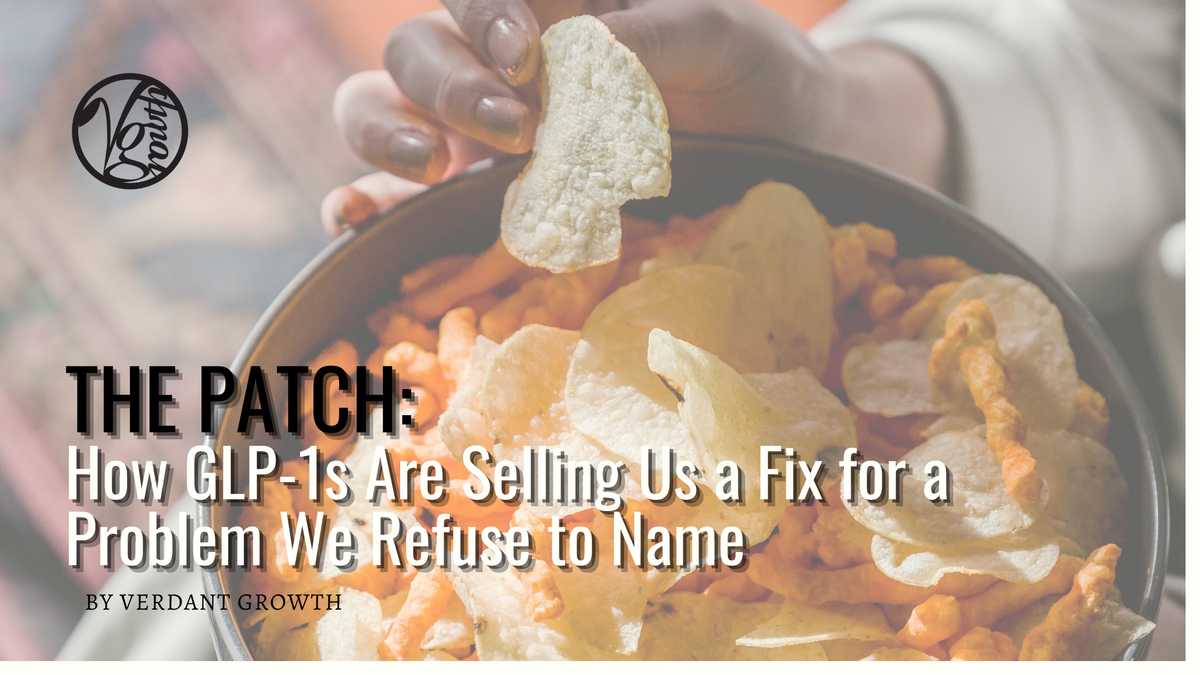
If you live in America (and probably elsewhere too), there's a feeling you're very familiar with: the snack cravings. Not being particularly hungry, but wanting to put something in your mouth. You go to your snack cabinet and there's the crispy crunch of Doritos, maybe the chewy, tangy sweetness of some Haribo gummy bears, or the salty, savory buttery crunchiness of some Ritz crackers…It's a feeling I'm all too familiar with and now try as hard as I can to fight - knowing you shouldn't eat any of it. It all barely counts as food and has almost nothing good for you in it and everything bad. Salt, sugar, fat…All of which you've probably already had plenty of today. But something in you wants it anyway. So you end up taking “just a few”, and we all know where that goes. Within an hour you've eaten half the bag and now there's nothing but guilt.
Breaking that pattern is hard enough, but now I think it's about to get a lot harder…Because now if you're having those cravings and overeating, it's OK! We have GLP-1s, the new $52 billion dollar industry drug that curbs your appetite!
Ugh.
Okay. Let's talk.
The Boom
Right now, GLP-1s are the biggest thing in pharma. I can't go anywhere, listen to a podcast, or open a news website without reading about how amazing GLP-1s are. Combined revenue from the major GLP-1 producers hit roughly $52 billion in 2024, growing over 60% year over year. And it's still early. Over a billion adults worldwide have obesity, and GLP-1 penetration is still under 4% of them. Meaning this isn't a peak. It's a running start.
The Real Parallel
Here’s the part that terrifies me: we didn't get here by accident. Someone engineered the craving. Food companies spent decades optimizing for one metric: keeping you eating as much as you can for as long as you can. Hyper-palatable, hyper-marketed, hyper-available. We didn't fail at willpower. They just made sure they were in our heads constantly. At the bus stop. On TV. At the front of each of the supermarket aisles.
But don't worry, for now comes the “fix!”
"Let's rebuild the food system?” Nope. "Let's ask why a bag of chips is $3 and a bag of spinach is $6?" No way. Just: “take this injection, and the noise goes quiet.”
I'm not anti-medicine. If GLP-1s help someone live better, that's absolutely real and it matters. But I can't help but notice when you zoom out, the pattern is uncomfortably familiar — it's the same one I keep writing about with plastic, with convenience packaging, and with cars: Create something to sell us. That something creates a problem. Sell the solution. Now we're paying big corporations before and after we eat!
The Monkey Brain
Underneath all of it is something older than marketing budgets — a brain built for a world of scarcity, but now living in abundance. We're wired to crave calories, salt, fat, sugar, because for most of human history those things were rare and worth chasing. If I dropped you off in the middle of a forest and told you to go find anything sweet, it would be very difficult. How often do you see apples or mangoes on your hikes? Our brain's wiring hasn't caught up to a world where salt, sugar, and fat are on every street corner, wrapped in plastic, and dirt cheap.
I keep coming back to this line, half-joking, half not: until we learn how to manage our own monkey brain, the companies will do it for us. One company sells the itch. Another sells the scratch.
Closing
I don't know anyone who woke up one day and chose to want fast food more than vegetables, or chose to need a $1,000-a-month injection to feel normal around food. Those wants got built into us, quietly, by people who stand to make big profits off of us.
Unfortunately, I don't see massive political movements attempting to curb rampant capitalism and brain washing (aka ‘marketing') us into buying everything they want us to. That means the responsibility falls on us to become aware of ourselves, our own habits, and our own desires. To figure out the exact shape of each, and try to understand: is this craving something I chose? Or is it just the one I inherited, and never thought to check?