Mainstream Culture Got It Backwards

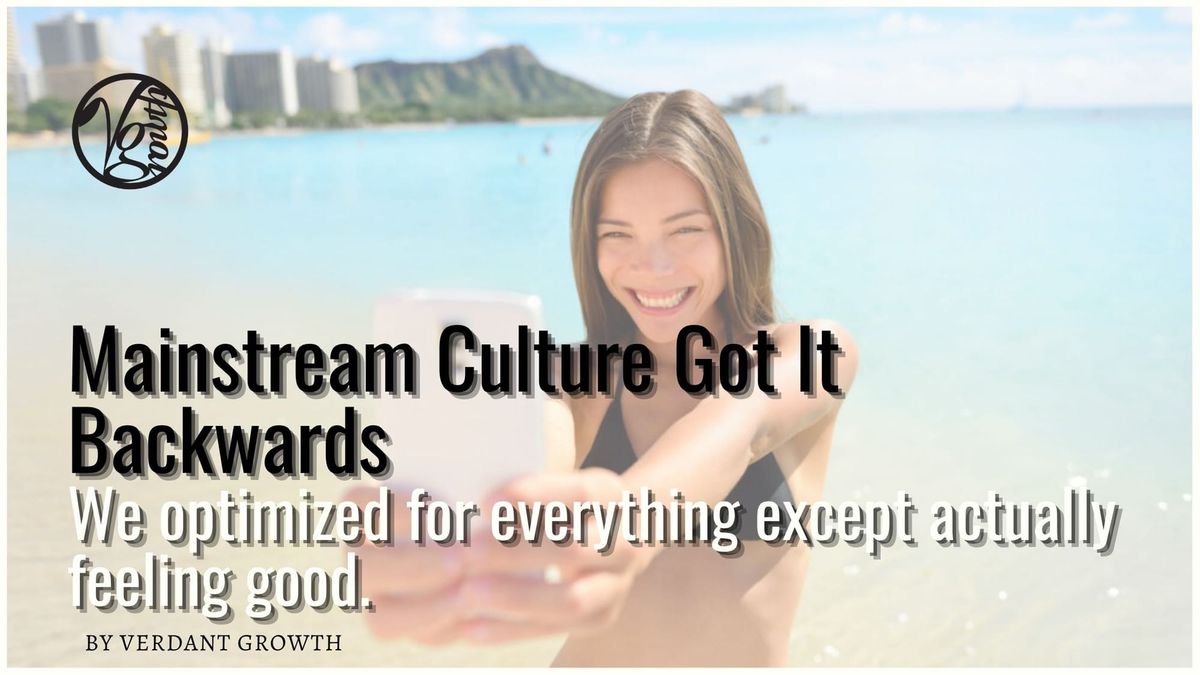
Last week I was in Waikiki and I saw something that I see all the time: A girl taking a selfie in front of the iconic, beautiful scenery of Waikiki beach. She pulled out her phone, flashed a huge smile with every one of her pearly white teeth showing, and snapped the photo. I see this all the time, but this time was different for me because I realized there’s something that happens at the end of this sequence of events: after snapping the photo, her face went blank. Like she was dazed or bored, even. The photo (I’m sure) told one story: I’m on vacation in the beautiful Waikiki, look at how amazing my life is and how happy I am! But her face and body language off camera told an entirely different story: I’m bored. I’m empty. And I realized I see this all the time, given that I live on Oahu, one of the tourist hotspots of the world.
The Promise
We work longer hours than ever before — not because we have to, but because we've been told that's how you win. We chase the promotion, the bonus, the house, the car. We call it success. And the promise, always just around the corner, is that once you have enough of it, the happiness will follow.
It doesn't, of course. Our millionaires become billionaires. Our billionaires push for trillions. If the formula worked, someone would have stopped by now. Elon Musk would be the happiest man on Earth. (I bet you he’s not even close)
Meanwhile we've handed our social lives to apps literally designed by psychologists to keep us scrolling. We feel connected — the likes, the comments, the replies — without any of the actual nourishment that human connection provides. We're more "social" than any generation in history and lonelier than any generation in history. At the same time. (These days I call social media “anti-social media.”)
We eat food like Doritos and frozen pizzas engineered for craving rather than health, then take handfuls of supplements to make up the difference. We are simultaneously the most medicated and the most health-conscious people who have ever lived. We now have drugs to save us from our own food addictions. (I’m looking at you, GLP-1)
We've optimized for everything except actually feeling good.
What We Actually Lose
Nobody chose this. Nobody woke up one day and decided to trade their peace for a packed schedule, or swap real friendship for a follower count. It happened gradually, the way it always does — one convenient app or service at a time, each one seemingly reasonable on its own.
But zoom out and the picture is hard to ignore. We are raising the first generation of kids who have to be taught how to make friends in person. We have more ways to communicate than any humans in history and an epidemic of loneliness to show for it. We are the most health-obsessed culture that has ever existed, and among the sickest.
Our time and attention are now bought and sold by corporations to maximize profit. Our food is designed to addict us and sell for the most profit, rather than nourish our health.
What we actually lost wasn't any one thing. It was the slow stuff. The stuff that doesn't show up in your productivity metrics or your bank account — the long dinners, the idle afternoons, the friendships that go deep because you had nothing better to do than really show up for each other.
That's not nostalgia. It's just what a real life feels like. And most of us can feel its absence, even if we can't name it.
What does “not backwards” look like?
I've had moments in my life that felt completely still. Not empty — still. Full of something that didn't have a name.
One was in a closet-sized room in a guesthouse in Korea, sitting on my tiny bed in the corner with the question of whether to stay or go home. Another was in a studio apartment in Japan, snow falling outside the window, holding a cup of coffee and thinking about a friendship I was afraid of losing. No productivity. No optimization. Just me, fully present with my own life. More recently, I’ve also had times when I sat with a bowl of homemade vegetable stew with veggies from the local farmers market that just felt nourishing as I appreciated what eating good food does for your body and your soul.
Those moments didn't make my highlight reel. I didn't post them. But they're the ones I actually remember — the ones that felt like mine.
That's what "not backwards" looks like. Not an Instagram page of slow living aesthetics. Not a perfectly optimized morning routine. Just a life where you're actually present for what's happening in it.
It looks like a meal cooked at home that took longer than it needed to. Clothes you've owned for a decade because you actually love them. Work that ends when it's supposed to end. A conversation with a friend that goes nowhere in particular and lasts three hours anyway.
The shift isn't about doing less. It's about what you're optimizing for. From productivity to presence. From convenience to care. From more to enough.
That's when life starts to feel like something worth living. Not because you finally achieved enough — but because you stopped waiting to.
That’s when it starts to feel like you’re living for you.
This Isn’t About Sustainability
Here's what I've come to believe: this isn't really about sustainability. Not at its core.
When I started trying to live more sustainably, I thought that was the goal. Reduce your footprint. Make better choices. Be one of the good ones. But the more I lived it, the more I realized I had it backwards. Sustainability isn't the destination — it's what happens naturally when you start optimizing for the right things. When you slow down, cook real food, buy less but better, spend time outside, build real connections with people — you end up living more lightly on the planet almost by accident. Because it turns out that what's good for you and what's good for the world aren't in conflict. They're the same thing.
That's what this is really about. Not guilt. Not sacrifice. Just a better life — for you, first.
Where to start
So where do you start?
Not by overhauling your life. Not by deleting all your apps or moving to a farm. Just by getting honest about the gap between how you're living and how you actually want to live.
Most of us already know what a good day feels like. We've had them. The question is why we don't design more of them.
So try one thing this week. Cook a meal that takes a little longer than it needs to. Go for a walk without your phone. Sit somewhere quiet for ten minutes and let your mind actually rest. Not to be productive. Not to optimize anything. Just to remember what it feels like to be present in your own life.
And if you could design tomorrow — really design it, from the moment you wake up — what would it look like? What would it feel like? What would a perfect day look like to you? Really think about it.
I promise it’s not waking up to doom-scrolling social media for an hour.
Because that answer is worth paying attention to.