
Cars aren’t freedom. They’re a cage.

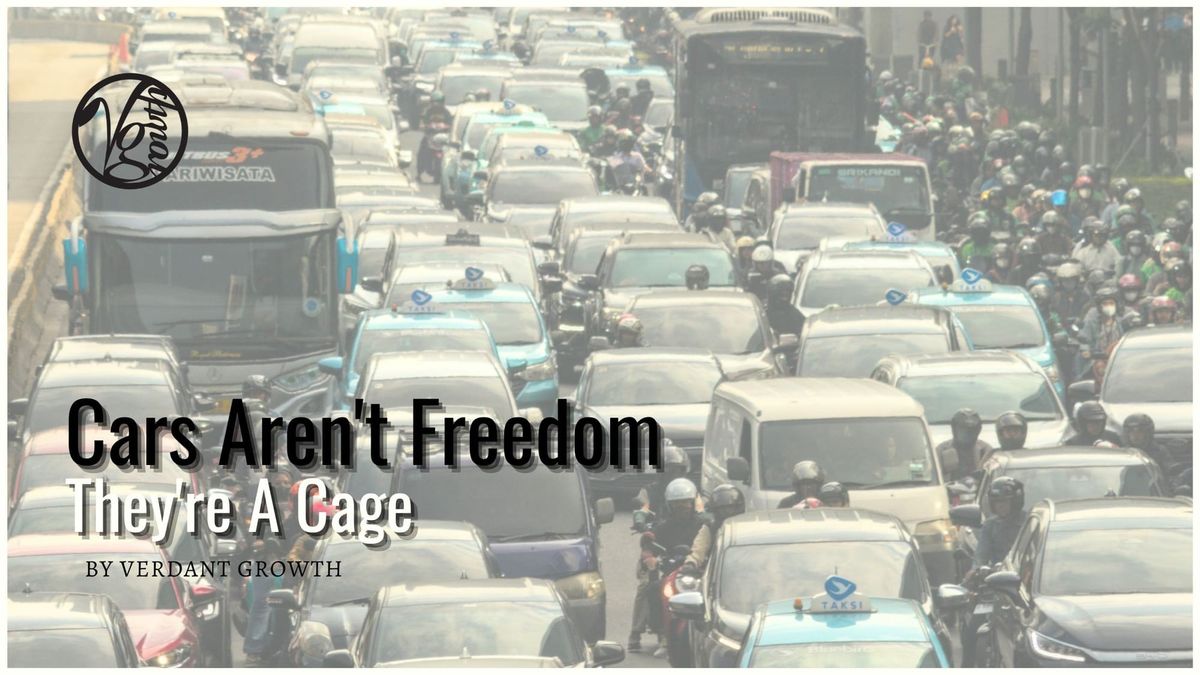
In 1974, an Austrian philosopher named Ivan Illich sat down and did the math on the American car. He added up everything — the driving, the parking, the hours spent earning money to pay for the thing, the gas, the insurance, the registration, the repairs. All of it.
He came up with 1,600 hours a year.
That's four out of every sixteen waking hours. Devoted to a car. And when he divided those hours by the miles actually traveled, he got the effective speed of the American automobile: less than five miles per hour. About the pace of a brisk walk.
The Numbers
Here's what makes that number land so hard. We think of car expenses as the obvious stuff — the monthly payment, the fill-up at the pump. But the real invoice is longer than that. There's insurance ($1,694 a year on average). Registration and taxes ($813 a year, per AAA). The payment itself, which on a financed average-priced car runs you nearly $64,500 over the life of the loan once interest is included. Depreciation — the largest single cost of ownership — quietly eating your asset from the moment you sign. Parking. Tolls. The repair that always seems to show up three weeks after your warranty expires.
AAA puts the total average cost of owning and operating a new car at $11,577 a year. At the median American wage, that's roughly 360 hours of work annually — just in dollars, before you've even counted time behind the wheel.
I haven’t personally run the numbers on my vehicle, but every time I have to take it to the shop for a $2k unexpected repair, it makes me think more and more that, financially, I just might be better off not owning a car.
Car: Optional?
Here's the part that should make you a little angry.
Here in America, the car didn't just get expensive. It made itself necessary. Or at least, the companies did. Through lobbying and buying politicians, cities were redesigned around it. Suburbs sprawled out past any reasonable walking distance. Bus lines got cut. Sidewalks disappeared. The places where you work, shop, eat, and live were gradually rearranged to assume a car was part of the deal. And once that happened, the car stopped being a choice. It became a necessity.
And the worst part is that we've completely accepted it. It's so engrained and normal to us that we can't imagine a world that's any different.
That's not freedom. That's a con…And we're all the marks.
To this day, every single time I'm stuck in traffic on the H-1 highway in Honolulu, fighting through tourist traffic for an hour to get to work, I think about how different my life was in Korea and Japan, both of which have amazing public transit: wherever I wanted to go, I could put the destination in Google Maps, and get precise times for when buses or trains depart and be sure I get exactly where I need to go right when I need to. And the best part? Instead of sitting in traffic the whole time feeling frustrated and angry, I was reading a book. Or watching Netflix. Or video-calling one of my family or friends. It may have taken longer per mile traveled, but instead of feeling like wasted time (I'm looking at you, traffic), it felt like protected quality time.
Here in the States, people balk at a $3 bus fare. I get it. Three dollars feels like a real cost in a way that car ownership somehow doesn't, because the car costs are so spread out — over months, over years — that they stop feeling like costs at all. They just feel like life.
Do the math. $11,577 a year is $965 a month. Just in dollars, that's about nine weeks of full-time work, gone, every single year. And that's before you count the actual hours spent driving, parking, and sitting in traffic — which is how Illich got to 1,600 hours, or a full forty weeks of your year. It’s an insane amount of time that honestly sounds too high to be true, but even if the numbers aren’t right, the point still stands: we spend a LOT of money and time for our vehicles despite the high cost because the dealership has a couch, the financing desk with a bottle of water and some free chips and everyone does it so somehow it all feels very normal.
For me personally? I can’t stop thinking that for $965 a month, I could probably even Uber everywhere I need to go and it would still cost less.
Still want your car?
Honestly, you probably do.
The car has become so embedded in what life looks like in America, that people can't see it as anything other than freedom. We're so brainwashed into thinking cars are necessary, that anything else feels like sacrifice and misery.
But take a moment to think about it. You don't have to sell your car right now (I haven't). By paying attention to how much this hunk of metal and four wheels costs, I've come around to understanding just how expensive and how forced-upon-me this thing is.
The car is probably the most successfully sold product in human history. Not because it's uniquely good, but because they made it the only option. The sales pitch was freedom. But when we look under the hood, the reality is dependency.
Illich calculated this in 1974. The numbers are worse now.
And I haven't even mentioned how many people die per year from the car-related pollution, automobile accidents, or getting hit by cars. Big hint: it's grim.
So I get it, you're not getting rid of your car. But here's the question I can’t stop thinking about: what would you do with 1,600 hours per year?