The Plastic Paradox: What One Scientist Got Right, What I'm Not Convinced About, and Why It Matters

[4/9/2026 - This post is about my recent podcast episode interviewing Chris DeArmitt. If you're interested in hearing the interview, you can find it here: https://verdantgrowth.blog/tslsfn-the-plastics-paradox-w-chris-dearmitt/]
There's a specific feeling you get when someone tells you something you want to believe — and you can't tell if it's because it's true, or because it would be really convenient if it were.
I got that feeling talking to Chris DeArmitt.
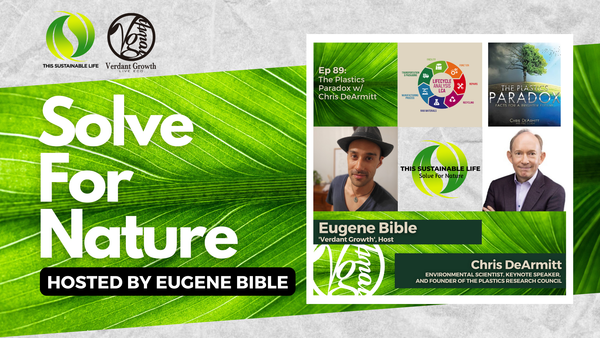
Chris is a PhD polymer scientist, Fellow of the Royal Society of Chemistry, and author of The Plastics Paradox. He's appeared on 60 Minutes and the BBC — he's probably had more time on the big, credible mainstream media outlets than most of the guests I’ve had. And his argument, stated plainly, is this: the science on plastics has been misrepresented, plastic is often the more environmentally responsible choice, and the natural alternatives we reach for — cotton, glass, wood — are frequently worse for the planet.
I know. I know.
And yet sitting across from him, I noticed a part of my brain quietly hoping he was right. There's something almost relieving about that idea — like finding out the thing you've been afraid of was never really the monster you thought it was. That's exactly when I knew I needed to pay close attention.
This post is my attempt to work through what he said, what I found afterward, where I think he's onto something, and where I think the picture is more complicated than he lets on. I'm not here to deliver a verdict — but I'm not going to pretend I walked away convinced, either.
Why I Gave Him A Voice
I'll be honest: I almost didn't invite him. On my podcast, I could choose to curate and screen guests and only platform voices I already agree with, and I'd be lying if I said that version wasn't easier. But I've come to think that in-group bias — the pull toward ideas simply because everyone around you believes them — is one of the more insidious forces in sustainability circles. If I ever got the chance to sit down with the CEO of ExxonMobil or Amazon, I'd take it in a heartbeat. Not to validate them, but because those are exactly the conversations worth having - the places where we most need to lead people to something better.
So I gave Chris the benefit of the doubt, asked him the hardest questions I could, and tried to stay genuinely open. Here's what I found when I went looking afterward.
My Honest Reservations
After the interview, I wanted to stay genuinely open. I don't believe a god exists, but if significant enough scientific evidence emerged that one did, I'd be obligated to update my belief. Plastics felt the same way. If the evidence really does point toward benign, I should be willing to follow it there.
So I went digging. And here's where I landed.
Chris runs a consultancy that serves plastics companies. He makes money when plastic gets used more. His keynote work is pitched at helping executives and reassuring investors that their bet on plastic is sound. None of that automatically makes him wrong — but it does mean his financial interests and his conclusions happen to point in the same direction, and I think that's worth naming. Researchers have also described him as a "merchant of doubt" involved in lobbying against the global plastics treaty. Maybe that's just environmentalists upset that someone challenged their assumptions. Or maybe it's meaningful. I genuinely don't know, but I noticed it.
To be clear: I'm not trying to build a case against him. I think he's come to his opinions honestly through an enormous amount of research I haven't done. I'm simply telling you where he comes from, so you can factor that in the same way I tried to.
The Science Isn't as Settled as He Implies
Here's the thing about Chris's "just read the science" framing: science is only as useful as the full picture it paints, and the full picture on plastics is not as clean as he implies.
Start with the basics. We produce staggering amounts of plastic, and the global recycling rate is 9%. In the U.S. it's dropped to around 5%. That means the vast majority of plastic ever made is still out there somewhere — in landfills, waterways, soil, and increasingly, in us. Chris argues it biodegrades. The science I’ve seen suggests not nearly fast enough. We make it faster than it biodegrades, and if nothing changes, we’ll be drowning ourselves in plastic over time.
On the health side, the research is young but the signals are hard to ignore. A 2024 study in The New England Journal of Medicine — not a fringe publication — found that patients with microplastics in their arterial plaque had significantly higher rates of heart attack, stroke, and death. That same year, the Endocrine Society, one of the world's leading bodies of hormone researchers, published findings linking plastic chemical additives to reproductive disorders, cancer, diabetes, and heart disease. Sure, it’s possible that these studies were biased against plastic, but these are well established institutions. These aren't activist groups with an agenda. These are mainstream scientific institutions publishing in peer-reviewed journals.
Chris would have a counterpoint to every one of those. He always does. And some of his counterpoints are valid, which I'll get to in a moment. But I noticed that his method of dismissing research he disagreed with was often a little too heavy-handed: entire bodies of work declared invalid, entire fields of study waved away. That pattern gave me pause. Skepticism is healthy. Blanket dismissal is something else. There’s a lot he’s choosing to sweep under the rug.
The honest summary: the science isn't settled. But unsettled doesn't mean evenly divided. From what I could find, it leans toward concern — and I think that matters.
Where He Actually Has a Point
Here's what I think is tricky about how Chris handles these conversations: some of what he says is just... right. I don’t think he’s trying to “trick” us into believing him, but he certainly has points that I do believe he’s right on woven into his arguments.
Lifecycle analysis is genuinely complicated. A reusable cotton tote requires enormous amounts of water and pesticide to produce. A glass bottle is heavy, energy-intensive to manufacture, and has to be reused dozens of times before it breaks even environmentally with a plastic alternative. The "plastic bad, natural good" shorthand that floats around sustainability circles is real, and it does real damage — it lets people feel virtuous about swaps that don't actually move the needle, and sometimes make things worse. A cotton tote is NOT always better for the environment. It depends on how it is used, and what the word “better” means.
He's also right that some anti-plastic research has been overstated. Science communication is imperfect, headlines are reductive, and genuine nuance gets lost. All headlines these days are designed to maximize clicks and big, inflammatory titles make everything seem like the end of the world. Some of it naturally becomes overblown, and even I am occasionally guilty of reading a title, assuming I already know what’s in the article, allowing me to get my dopamine “I knew it! I’m right again!” hit, then not even reading the article and moving on.
His point about applications is one I keep coming back to. Should a replacement heart valve be made of wood because wood is natural? Of course not. There are places where plastic is genuinely the best material for the job, and very nuanced and difficult conversations are not had nearly as often as they should be.
I don't think Chris is wrong about everything. I think he's someone who has identified real weaknesses in the anti-plastic argument and built his entire worldview around them — which makes him a valuable voice to engage with, even when I think he goes too far.
The Point That Stands Regardless of Who's Right
I’ve spent a lot of time over the last couple of weeks pondering this, and here's where I keep landing, no matter how many times I turn this over.
Even if Chris is right about everything — even if every study he cites holds up, every alternative material turns out to be worse, and plastic proves to be more benign than we feared — we still have a problem. And the problem isn't the material. It's us.
We live in a world built around disposability. The assumption baked into modern consumption is that things are meant to be used once, briefly, and discarded — and that someone or something else will deal with the consequences. That assumption is the crisis, regardless of what the thing is made of. Garbage is bad whether it's plastic, glass, cotton, or wood. Waste is waste. And we generate it at a scale that no material science argument can make okay.
I live in Honolulu. The ocean is not an abstraction for me. It’s literally all around me. And what washes up on these shores isn't a materials science debate. It's the physical result of a culture that has decided convenience is worth more than consequence. I don't think Chris would disagree with that, actually. I think if we sat down again and steered the conversation there, we may find more common ground than you’d think.
That's the shift I'm really after: while we’re all sitting here arguing over which material to use, we’re continuing to pump out material goods for maximizing profit and consumption. We need a fundamental rethinking of how much we consume and how casually we discard. Reduction over substitution. Intentionality over habit. Less, done better. Or better yet, none at all.
That's true whether plastic is the villain or not.
Wrapping Up
This post ended up longer than I planned, which probably tells you something about how much this conversation stuck with me.
Chris, if you're reading this: I don't think you're trying to deceive anyone. I think you've arrived at your convictions through an amount of research I haven't done and probably won't. I respect that. I also think there's more conversation to be had — and honestly, I'd like another shot at it. Not to relitigate the materials debate, but to get at something underneath it: what you value, what kind of world you want, and where that might connect with what I'm trying to build here at Verdant Growth. I think you'd find it more interesting than you might expect. The offer stands.
For everyone else: go listen to the episode before you make up your mind. I tried to give Chris a fair hearing and ask real questions — whether I succeeded is for you to judge. When you're done, come back here and tell me what you think. Were you convinced by him? Did I push back hard enough? Did I get something wrong? I mean that genuinely — I'm not looking for validation, I'm looking for the conversation to continue.
Because that's the whole point, isn't it? Not to be right. To keep getting closer to it.